Mist: Can we possess ourselves in digital world?
Over two years ago, while working on the AO.space project, I wrote an article titled "Mist:Do we own our data?".
Now, with the increasing power of AI and the increasingly intense data devouring and demanding by platforms, I deeply feel that it's no longer just a question of data ownership, but whether we can still possess ourselves in the digital world, and whether human development will be lost in the digital world.
Therefore, I recently wrote this article again, "Mist: Can We Possess Ourselves in the Digital World", thus beginning a series of discussions on the people, data, and systems. Mist、Exploration、Homefield is the author's Digital Autonomy Trilogy of overviews on individuals, data, and systems. This is the first article, "Mist".
What is the Digital World?
Since the birth of the world's first general-purpose computer, ENIAC, in 1946, the digital world, like the Big Bang, has occupied our lives in just 80 years. According to the TouchPoints annual survey published by the Advertising Practitioners Association (IPA) in the UK, British adults spend nearly 7.5 hours a day in front of screens. This means that, aside from sleeping, they live half their lives in the digital world. The expansion of the digital world far exceeds our imagination!
Compared to the explosive development of the digital world, the real world can be said to have stagnated 😃.
Various types of computers (computers, mobile phones, servers, smart devices, internet platforms) are the carriers of the digital world, connecting the real world and digital world. Once, computers were considered merely advanced calculators, mobile phones were simply portable versions of landline phones, or high-end cordless telephone; the digital world was just a futuristic fantasy in science fiction.
But as the new generation of AI surpasses human capabilities in many aspects, I can't help but wonder: will humans still dominate the digital world in the future? If not, then in the real world, can humanity continue to evolve and avoid being eliminated in the face of digital AI + robots?
Intelligence in the Digital World
The 1950 paper Computing Machinery and Intelligence by Alan Mathison Turing, the father of artificial intelligence, and the 1958 unfinished manuscript The Computer and the Brain by John von Neumann, the father of the the modern computer, both offer insights into the thoughts and perspectives of our computer science pioneers regarding machine intelligence.
One of the classic lines from Turing's paper is, 'Can machines think?' I believe to be too meaningless to deserve discussion. And right before this line, Turing predicted that by the end of the 20th century, computers would be able to pass the Turing Test through programming, making it impossible for interrogators to distinguish between human and machine answers. The original text used the title "The Imitation Game" (the English title of the classic 2014 film starring Benedict Cumberbatch), which became known as the Turing Test.
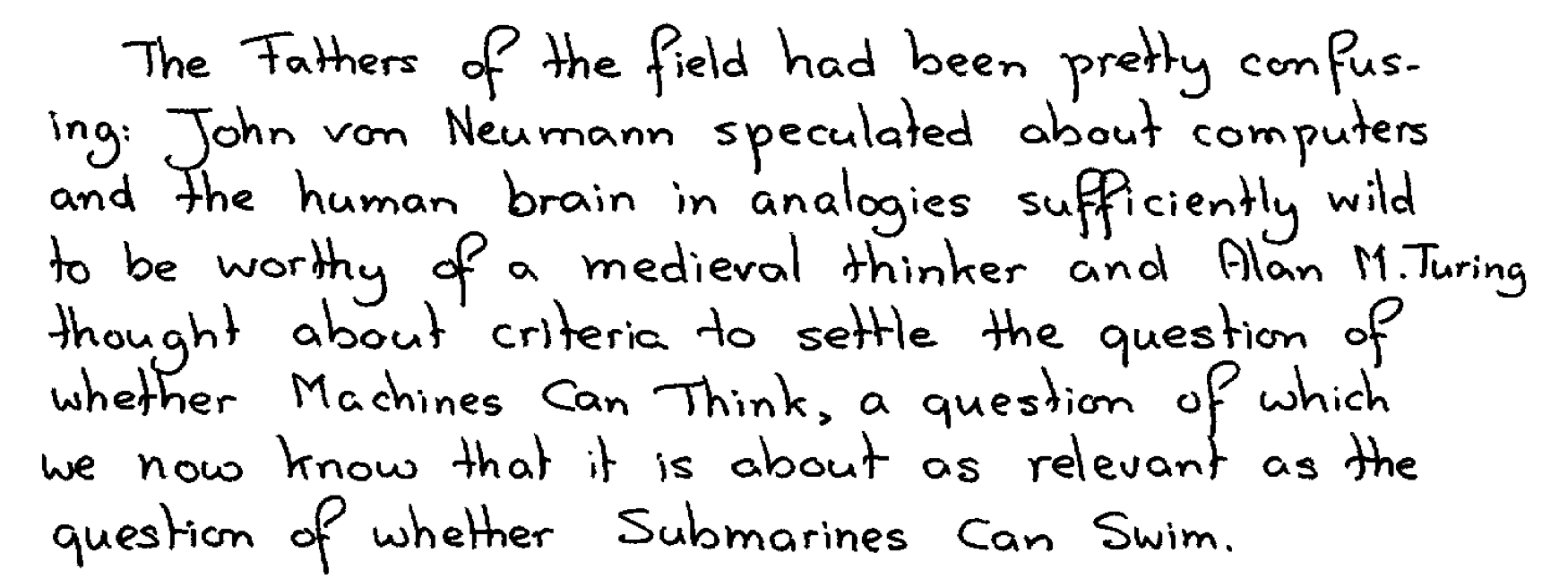
Another computer scientist, Edsger W. Dijkstra (yes, the author of the classic shortest path algorithm Dijkstra), also made a classic "submarine" argument in his 1984 manuscript, The Threats to Computing Science: the question of whether machines can think is similar to the question of whether submarines can swim.
This way of thinking is called functionalism. It's actually very suitable for engineers, avoiding getting bogged down in profound philosophical thinking and allowing us to focus on problem-solving and technological advancement.
Individuals, Data, Systems
In the real world, from ancient times to the modern era, the development and evolution of our world has always been built by individuals, data, and systems. Data is information; from oracle bone script to short videos, it is the exchange and evolution of data that promotes social development and productivity progress. Systems are society and ecosystems, allowing the world to evolve organically together. In the digital world, it's still about individuals, data, and systems. Only here, information is completely deconstructed into 0s and 1s. Systems are composed of software and hardware systems—the silicon-based world. An individual in the digital world can be understood as a digital mirror image of themselves, created by various accounts they've registered.
Illusion
While individuals in the digital world appear to be digital mirror images of their real-world counterparts, they are often completely controlled by the system. Even more worrying is the recent power of AI, which has made us realize that programs can replace individuals in the digital world, making the existence of individuals (humans) in the digital world seem optional.
The significant advancements in AI technology in recent months, coupled with news of various company layoffs, suggest that AI replacing humans seems irreversible.
So, should we thing about AI and worry about it from the perspective of overall human development?
Enter into the mist
Since we are engineers, let's return to a functionalist approach to these issues.
AI's Impact on Productivity
AI technology's impact on productivity is indeed epoch-making, much like the invention of the automobile improved transportation efficiency. One person plus AI can indeed replace many types of work that previously required two, ten, or even more people. Therefore, this technological advancement will inevitably have a significant impact on existing jobs in the short term.
However, before worrying, remember that AI is a tool, an amplifier of individual capabilities. AI needs to be used effectively to realize its full value.
Just as drivers were rendered obsolete without learning to drive, AI tools require learning to use.
AI's Impact on Society
AI will increase social productivity, giving technology the opportunity for leapfrog development and further improving the socio-economic level.
AI will be further integrated into the actual work of various industries, improving productivity across all sectors.
An uncertain impact is how social wealth will be redistributed, just like every productivity revolution. (This sentence was learned from my mentor)
Will AI Dominate the Digital World?
Not currently. The real threat comes from the people behind the systems (data platforms, AI platforms). Will the digital world be completely monopolized by a few oligarchs through AI? Can this be prevented? These are real questions that will affect development competition between nations.
Moreover, current AI technology is essentially still token prediction, not autonomous intent. No matter how complex the work AI does, someone wants it to do it that way, someone wants to use it to do that way. Therefore, another real threat is that someone uses AI's capabilities for malicious purposes, or that someone abuses AI and does things out of control.
Sharing
Therefore, looking beyond the mist, the real problem we face is still a human problem: improving our own capabilities, interpersonal relationships, and security precautions.
I've recently been learning and using AI for collaborative development, and here are some experiences I've gained for your reference:
- Basic Principle: AI is just a tool, and it can make mistakes. Use AI in a controlled manner.
- Never leak personal information to AI platforms.
- Continuously learn and improve your skills and knowledge; this will give you greater capabilities when using AI.
- Before using AI, determine what you want.
- When using AI, for information you don't know or are unsure about:
- Verify with other authoritative sources before using it.
- Further study and understand any knowledge gaps.
- Don't hesitate to abandon anything difficult to understand and regenerate it.
- AI-Assisted Programming
- Determine test cases, API design, and documentation before generating code.
- Read through the code line by line; you'll often find unexpected surprises.
- Thoroughly review critical code.
- Let the AI review the code itself; if possible, have two AIs cross-review the code.
The AI frenzy will eventually cool down, and the mist will gradually dissipate. May humanity's future remain in our hands, and may the world be at peace!
Author's Note:
The original article was entirely written by the author, without the use of AI or AI editing. This approach is especially valuable in today's world.
Articles in different languages will be translated using translation tools based on the original text, and each sentence will be verified.
Reference Links
- [1]: COMPUTING MACHINERY AND INTELLIGENCE by A. M. Turing
- [2]: The Computer and the Brain by John von Neumann
- [3]: The threats to computing science by Edsger W. Dijkstra